
Article: Pet Nat vs Skin Contact Wine: What's the Difference?
Pet Nat vs Skin Contact Wine: What's the Difference?
Pet nat and skin contact get mentioned in the same breath so often that it’s easy to assume they’re two versions of the same thing, but they’re not. Pet nat is about how a wine gets its bubbles, and skin contact is about how a white wine gets its colour and texture. One is fizz, the other is grape skins.
The mix-up is understandable, because they usually sit side by side on a wine list, somewhere near the words “something a bit different”. Both can be a little cloudy, both have a loyal following, and both tend to get ordered by whoever at the table wants to try the interesting thing. You can absolutely have one without the other, though, and every now and then you’ll find both in the same bottle.
What is pet nat?
Simply put, pet nat is short for pétillant naturel, which is French for “naturally sparkling”. It’s a sparkling wine that gets bottled before its first fermentation has finished, so the last of that fermentation happens inside the bottle and the bubbles have nowhere to go.
The technique is called méthode ancestrale and, as the name suggests, it has been around longer than the method used for Champagne. Where Champagne is fermented twice, with sugar and yeast added to kick off the second round, pet nat is fermented just once and nothing is added to make it fizz.
You can taste the difference straight away. The bubbles are softer and more relaxed than Champagne or prosecco, and because most pet nats aren’t filtered, the wine is often a little cloudy with some sediment at the bottom of the bottle (completely normal, and harmless). It usually comes sealed with a crown cap, so it opens like a beer, and it’s at its best young, cold and without too much ceremony.
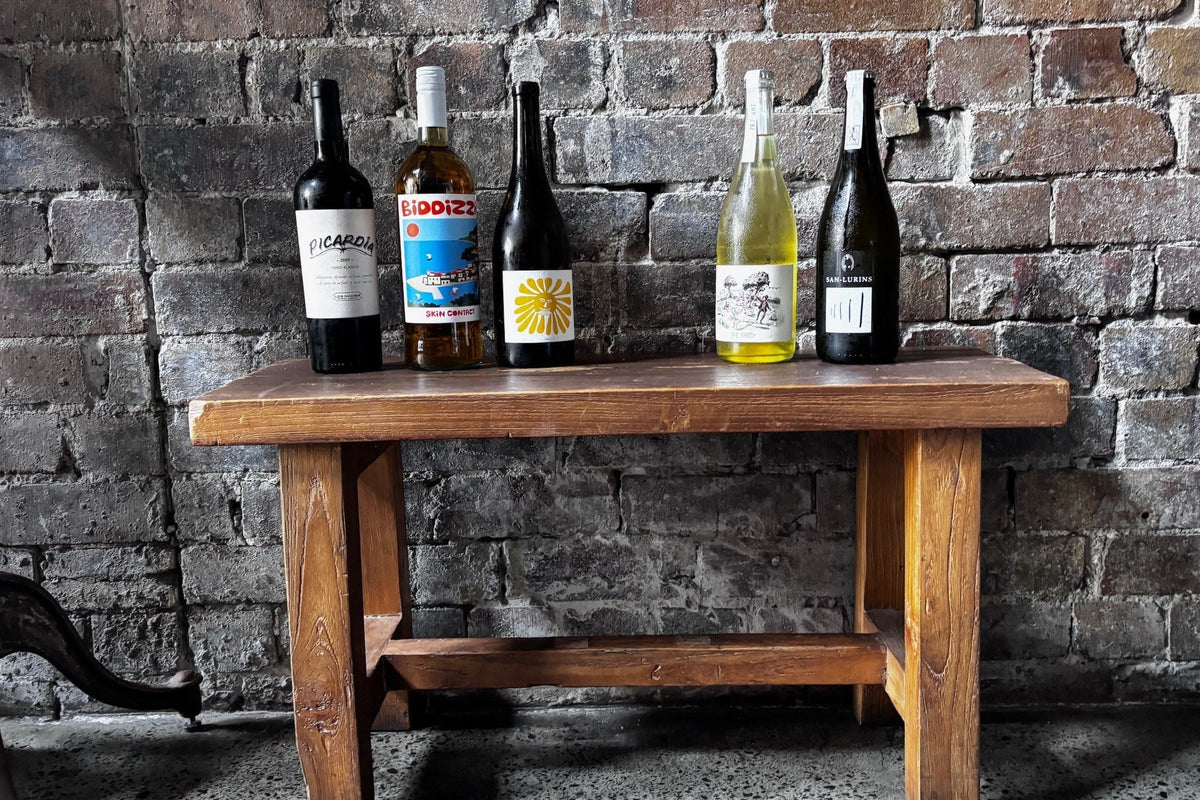
It can also be just about any colour and made from just about any grape. On our list, San Lurins makes theirs from Malvasia Istriana in Friuli, in Italy’s north-east, while See Saw blends Riesling and Marsanne for a bottle called ‘The Party’. That one is worth remembering, because it comes from Orange in New South Wales, which makes it a pet nat from Orange that isn’t an orange wine — you can see how the confusion starts!
What is skin contact wine?
Skin contact wine is white wine made the way red wine is made. Instead of pressing the juice off the grape skins straight away, the winemaker leaves the two together, sometimes for a few days and sometimes for several months.
That time on skins changes almost everything about the wine. Most whites are pale and crisp precisely because the skins are taken out early, so when they’re left in, the colour deepens to gold, amber or a proper orange. The wine also picks up tannin, which is the gentle, drying grip you’d normally associate with red wine, and the flavours drift away from fresh fruit and towards dried apricot, tea, nuts and orange peel.
This is why you’ll also hear it called orange wine or amber wine. All three names mean the same thing, and none of them has anything to do with oranges. It’s hardly a new idea, either. Winemakers in Georgia have been making wine this way in clay vessels for around 8,000 years.
You won’t always find the words “skin contact” on the label, which doesn’t help. Commune of Buttons call their Adelaide Hills Chardonnay ‘Macerated’, which is simply the winemaker’s word for the same thing. Domaine Simha’s ‘Sanskrit’ Pinot Gris, from Tasmania’s Derwent Valley, comes at it from another angle. Pinot Gris has pink-grey skins, so a bit of time on them gives the wine a coppery colour and far more texture than the pale pinot grigio most of us know.
Skin contact wines are usually still, not sparkling, and how bold they taste comes down to how long the skins stayed in. A few days gives you a white with a little extra texture, while a few months gives you something savoury and structured that drinks more like a light red.
Pet nat vs skin contact, side by side
| Pet nat | Skin contact | |
|---|---|---|
| What the name describes | How the wine becomes sparkling | How long the juice sits on the grape skins |
| Also called | Pétillant naturel, méthode ancestrale | Orange wine, amber wine |
| Bubbles | Yes, soft and gentle | Usually none |
| Colour | Any: white, rosé, red or orange | Gold through to deep amber |
| Texture | Light, fresh, lively | Grippy, textured, savoury |
| Typical flavours | Crisp fruit, citrus, a yeasty edge | Dried apricot, tea, nuts, orange peel |
| Closure | Usually a crown cap | Usually cork or screw cap |
| Serve | Well chilled | Lightly chilled, not ice cold |
| Order it when | You want something fizzy to start | You want a white with the weight to go with food |
Can a wine be both pet nat and skin contact?
Yes, and it’s less unusual than it sounds. Because one term is about bubbles and the other is about skins, there’s nothing stopping a winemaker from doing both: leaving white grapes on their skins, then bottling the wine before it has finished fermenting. What you get is a sparkling orange wine, usually labelled as an orange or skin contact pet nat.
Are pet nat and skin contact natural wines?
Often, but not automatically. Both styles are loved by low-intervention winemakers, which is why they so often end up together on natural wine lists. Strictly speaking, though, pet nat and skin contact are techniques, while natural wine is a broader approach to farming and to what does or doesn’t get added along the way. A wine can be one without being the other.
Which one should you order?
The easiest way in is to start with what you already like.
If you usually reach for prosecco or a dry sparkling, try a pet nat. It’s the friendlier, less polished cousin, and See Saw’s ‘The Party’ is an easy place to begin. If you lean towards textured whites or lighter reds, go for a skin contact instead. Domaine Simha’s ‘Sanskrit’ Pinot Gris is a gentle introduction, and the Commune of Buttons ‘Macerated’ Chardonnay is a good next step once you’ve got a taste for it.
And if you still can’t decide, just ask!
What to eat with each
Pet nat is an aperitif at heart. All that freshness is at its best alongside salty, crisp and raw things, so think oysters, crudo, olives and anything fried.

Skin contact is more of a food wine. The tannin and savoury edge mean it can stand up to dishes that would flatten a delicate white, like grilled vegetables, tahini, lamb, hard cheese and anything with a bit of spice or char. That makes it a natural match for Mediterranean share plates, where one bottle has to keep up with everything on the table.
At Coogee Wine Room the list runs to more than 500 wines, so there’s plenty of room for both, and you’ll find most of them under Skin Contact & Minimal Intervention on our wine list. Tell the team what you usually drink and they’ll point you to the right bottle (no judgement if you just ask for “the orange one”).
Book a TableFrequently asked questions
Is pet nat the same as orange wine?
No. Pet nat is a sparkling wine made by finishing fermentation in the bottle. Orange wine is a white wine fermented on its skins. A pet nat can be orange if it was also made with skin contact, but most are not.
Is skin contact wine the same as orange wine?
Yes. Skin contact, orange wine and amber wine all describe white grapes fermented on their skins.
Is pet nat sweet?
Usually not. Most pet nats are dry or just off-dry, though some keep a little natural sweetness because fermentation stops in the bottle.
Why is pet nat cloudy?
Because it is rarely filtered. The sediment is leftover yeast from fermentation, and it is harmless. Stand the bottle upright and chill it well before opening if you want a clearer pour.
Is pet nat the same as Champagne or prosecco?
No. Champagne gets its bubbles from a second fermentation in the bottle. Prosecco gets them from a second fermentation in a tank. Pet nat is fermented once and finishes in the bottle, which gives it a softer fizz.
Does skin contact wine taste like red wine?
Somewhat. It has tannin like a red, but the flavours stay in white wine territory: stone fruit, citrus peel, tea and nuts.
Should skin contact wine be chilled?
Lightly. Around 20 minutes in the fridge is enough. Served too cold, the tannin tastes harsh and the flavour closes up.
Is rosé a skin contact wine?
Technically, yes, but the other way around. Rosé is made from red grapes with brief skin contact. Orange wine is made from white grapes with extended skin contact.


Leave a comment
This site is protected by hCaptcha and the hCaptcha Privacy Policy and Terms of Service apply.